Survey of Pakistan Assistant Director Test Syllabus, Past Papers, and Salary Structure
Securing a position as an Assistant Director (AD) in the Survey of Pakistan (SoP)—a premier National Mapping Agency functioning under the Ministry of Defence—is one of the most prestigious career milestones for ambitious Pakistani professionals. Operating under the federal government infrastructure, this Basic Pay Scale 17 (BPS-17) cadre offers robust job security, professional authority, and a highly competitive compensation framework.
However, transitioning from an aspirant to an appointed officer requires navigating a rigorous, highly specialized recruitment process typically administered by the Federal Public Service Commission (FPSC). This expert guide breaks down the technical details of the test syllabus, analyzes past paper trends, and clarifies the complete, up-to-date salary structure for an Assistant Director in Pakistan.
The Financial Package: Assistant Director BPS-17 Salary & Allowances
Understanding the financial realities of federal employment is critical for strategic Career Planning. In the federal pay scale system of Pakistan, the initial basic pay for a newly appointed BPS-17 officer starts at a fixed baseline, which scales dynamically with annual increments and civil service allowances.
The table below outlines the comprehensive monthly salary breakdown for a newly recruited entry-level Assistant Director in the federal capital or provincial regional headquarters.
BPS-17 Compensation Matrix (Federal Scale)
| Salary Component | Specific Technical Metric / Valuation |
| Basic Pay Scale Baseline (BPS-17) | PKR 45,070 (Starting stage) |
| Annual Increment Rate | PKR 3,420 per annum |
| Maximum Scale Ceiling | PKR 113,470 |
| House Rent Allowance (HRA) | 45% of basic pay (or official accommodation) |
| Conveyance Allowance | PKR 5,000 fixed |
| Medical Allowance | PKR 1,500 fixed |
| Adhoc Relief Allowances | Compounded percentages based on latest federal budgets |
| Gross Monthly Starting Salary | PKR 85,000 to PKR 95,000 (Varies slightly by region) |
| Statutory Deductions | General Provident (GP) Fund ($\approx$ PKR 6,350), Benevolent Fund, Group Insurance |
Recruitment Architecture: The Selection Pipeline
The competitive selection mechanism for the Survey of Pakistan relies on standard screening and subjective analysis to maintain strict merit-based appointment protocols.
1.Online Profile Profile & Challan Submission:Step 1: Application Portal.
Aspirants must submit an application through the official FPSC online portal. This requires processing an explicit application fee via a National Bank of Pakistan (NBP) treasury challan form.
2.Phase-I: Objective Screening Examination:Step 2: One-Paper MCQs.
Candidates undergo a 100-mark, 100-minute objective type multiple-choice test. There is zero negative marking, and the question structure heavily tests analytical intelligence and English proficiency.
3.Phase-II: Written Subjective Test:Step 3: Descriptive Analysis.
Top short-listed candidates (typically at a 1:10 or 1:5 post-to-candidate ratio) are called for a descriptive examination focusing on English essay writing, precise drafting, and technical professional modules.
4.Phase-III: Document Verification & NOC Check:Step 4: Credentials Scrutiny.
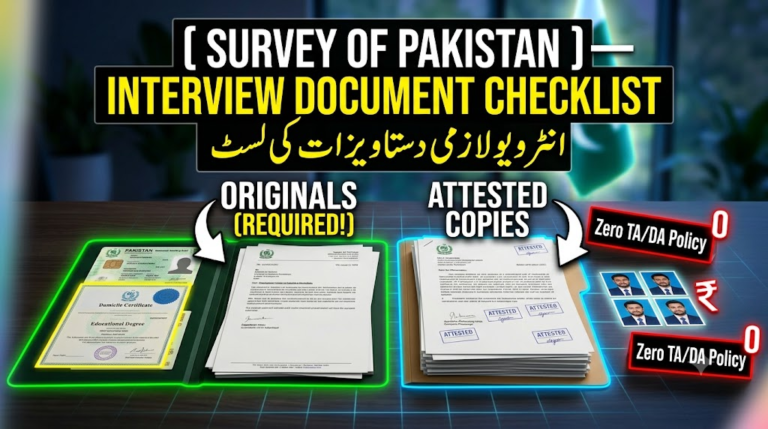
Candidates must provide certified academic credentials, domicile certificates, and an official No Objection Certificate (NOC for Government Servants) if currently employed in any public department.
5.Final Phase: Psychological Assessment & Panel Interview: Step 5: Merit Determination.
Also Read More: Survey of Pakistan Salary & Benefits BPS-04 to BPS-15 scale
The final selection hinges on a specialized psychological profiling exam followed by a structured interview conducted by a central FPSC panel panel to evaluate leadership competency and technical suitability.
Official Test Syllabus Breakdown
The screening phase uses a structured, two-part test pattern designed by federal test bodies to isolate highly competent candidates.
Part-I: English Language Module (20 Marks)
This section assesses command over the English language through SLO-based testing (Student Learning Outcome evaluation metrics).
- Vocabulary: Synonyms, antonyms, advanced contextual phrase selections, and high-frequency idioms.
- Grammar Usage: Technical syntax rules, correct prepositional placement, and subject-verb agreement validation.
- Sentence Structuring: Identifying passive/active mechanics, direct-to-indirect transformations, and structural errors.
Part-II: General Intelligence & Professional Knowledge (80 Marks)
This section acts as the primary differentiator for shortlisting competitive aspirants.
- Basic Arithmetic / Mathematics (20 Marks): Core algebraic manipulations, financial ratios, percentages, geometric proportions, and calculated arithmetic means.
- Current Affairs (20 Marks): Comprehensive tracking of national and international geopolitical shifts, bilateral treaties, global economic indices, and major events over the last 24 months.
- Everyday / General Science (20 Marks): Fundamental biological mechanics, chemical composition matrices, atmospheric sciences, physics rules, and general environmental changes.
- Pakistan Affairs & Islamic Studies (20 Marks): Basic level historical frameworks from 712 AD to the post-partition constitutional evolution of Pakistan, along with core principles of Islamic history, ethics, and jurisprudence.
Past Paper Analysis & Core Preparation Tips
An analysis of past paper data from the last five assessment cycles reveals that candidates who fail the exam generally stumble on time management or rely too heavily on outdated, generic guidebooks. To ensure your preparation aligns with high-value standards, adopt the following actionable checklist:
- Prioritize the “Dawn” Editorial Strategy: The Current Affairs and English components overlap significantly with the vocabulary and stylistic content found within high-tier news publications like The Dawn. Dedicate 45 minutes daily to evaluating editorial opinion pages.
- Solve High-Value MCQs via Specialized Portals: Rather than memorizing static answers, practice sample questions derived from original federal testing scripts. Focus on understanding the logical rule behind everyday science and basic mathematics formulas.
- Track the Chronology of the Civil Service Framework: For Pakistan Affairs, construct a structural timeline detailing the progression of basic constitutional reforms, federal pay adjustments, and historic governance structures within Pakistan.
To supplement your learning strategy with deep insights from academic experts, analyzing past structural trends can provide an incredible edge over the competition. For a deeper breakdown of competitive exam architectures and step-by-step strategies to crack BPS-17 one-paper exams, this PPSC and FPSC Preparation Strategy Guide provides an excellent tactical roadmap for aspiring federal officers.