Expected Exam Test Centers for Survey of Pakistan Screening Test: Complete Guide
For candidates applying to federal positions within the Survey of Pakistan (SoP), understanding the operational logistics of the selection process is just as critical as academic preparation. Whether you have applied for technical cadres like Surveyor (BPS-11) and Technician (BPS-14), or officer ranks like Assistant Director (BPS-17), your initial gateway is the official screening examination.
Administered principally by federal testing authorities such as the Federal Public Service Commission (FPSC) or specialized testing agencies, these examinations are conducted concurrently across pre-designated regional hubs. Missing your assigned venue or failing to understand center assignment protocols can result in immediate disqualification. This professional guide breaks down the expected exam test centers for the Survey of Pakistan screening test, spatial allocation metrics, and essential center modification protocols.
Regional Logistics: Expected Exam Test Centers Matrix
To facilitate candidates from all provinces and administrative territories, the department establishes test centers in major metropolitan hubs. Test center allocation is closely mapped to the candidate’s permanent or current address domicile listed during the portal registration phase.
The table below outlines the primary and secondary screening test locations, regional coverage parameters, and standard infrastructure modules utilized during federal examinations.
Federal Screening Test Center Framework
| Primary Exam Hub | Expected Institutional Venues | Regional Domicile Coverage | Facilities & Security Protocols |
| Islamabad / Rawalpindi | FPSC Examination Halls, Sector H-8 / Government Colleges | ICT, Azad Jammu & Kashmir (AJK), Northern Punjab | Biometric verification, CCTV monitoring, Jammers active |
| Lahore | Government High Schools (Allama Iqbal Town / Wahdat Road) | Central & Southern Punjab regions | High-capacity seating, dedicated invigilation teams |
| Karachi | FPSC Regional Office (Block 5, Clifton) / Public Universities | Sindh (Urban & Rural cadres) | Dual-shift testing layouts, secure locker systems |
| Peshawar | Government College of Technology / University of Peshawar | Khyber Pakhtunkhwa (KP) & merged tribal districts | Mandatory security clearance, localized screening blocks |
| Quetta | FPSC Regional Complex, Samungli Road / Local Public Schools | Balochistan Province districts | Centralized monitoring, strict verification desks |
| Gilgit / Skardu | Government Degree Colleges for Boys | Gilgit-Baltistan territories | Climate-controlled seating, verified postal tracking |
Operational Walkthrough: Testing Day Center Navigation & Security Pipeline
Navigating the exam center smoothly requires strict adherence to institutional verification pipelines. Federal guidelines dictate an unyielding checklist for entry into secure examination blocks.
1.Initial Identity Sifting & Document Verification:Phase 1: Verification Gate.
Candidates must present their original Computerized National Identity Card (CNIC) alongside a printed copy of the official Roll Number Slip. Photocopies or digital copies on mobile devices are strictly rejected.
2.Electronic Gadget Deposition & Physical Frisking:Phase 2: Security Clearance.
All electronic communication assets, including smartphones, smartwatches, digital calculators, and storage drives, must be deposited outside the examination boundary. Specialized metal detectors are used for physical scanning.
3.Biometric Validation & Seat Mapping Check:Phase 3: Desk Localization.
Invigilation teams cross-reference the candidate’s roll sequence against the master registry sheet layout. Biometric fingerprint authentication or facial logging may be conducted before desk allocation.
4.Attendance Log Signing & Verification Endorsement:Phase 4: Document Execution.
Once seated, the candidate must sign the official attendance roll matrix and apply their left thumb impression. Ensure the invigilator signs your specific question book and optical mark recognition (OMR) bubble sheet.
Critical Rules for Test Center Management & Venue Changes
1. The Hard Boundary on Center Modification
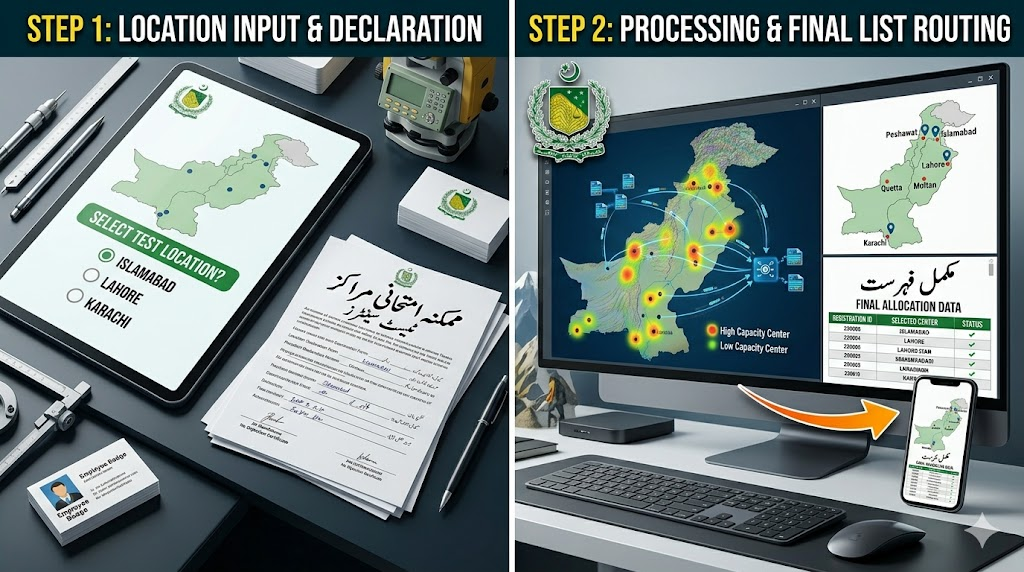
When submitting your digital application profile via national test body portals, the test center choice locked during submission is considered final. Testing authorities generate seat allocation indices, distribute exam question packages, and deploy specialized invigilation staff based on these exact volumetric ratios. Center change requests via email or helplines are generally rejected unless an exceptional administrative emergency arises.
2. Departmental Allocation Buffers
In cases where a specific regional center receives a high volume of candidate registrations that exceeds institutional room boundaries, the federal testing body reserves the right to shift a subgroup of applicants to the nearest secondary testing site. If this occurs, updated structural tracking vectors will be visibly printed onto your downloadable roll number portal slip.
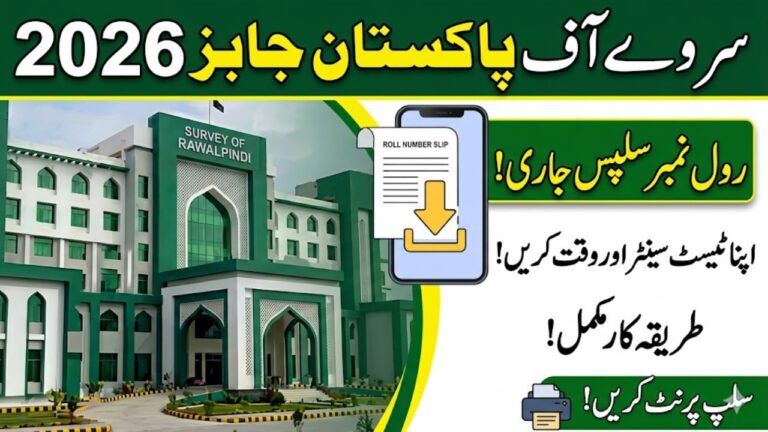
Also Read More About: Survey of Pakistan Duplicate Roll Number Slip Download Process
3. Strict Rules for Government Servants
Candidates appearing under the civil servant quota who have submitted an official No Objection Certificate (NOC for Government Servants) must ensure their chosen center matches their current region of official posting, or their registered permanent home station domicile footprint.
Actionable Testing Day Checklist for Aspirants
To ensure zero friction on your screening test date, execute this operational checklist 24 to 48 hours prior to the session:
- Download the Final Roll Slip Version: Re-login to the official testing portal 48 hours before the exam to print the most up-to-date version of your roll slip, checking for any last-minute institutional center adjustments.
- Locate the Center Physically: If your assigned venue is in an unfamiliar urban area, track the exact spatial location using navigation tools the day before to estimate transit delays.
- Arrive 60 Minutes Prior: Gate operations across federal screening halls close exactly 15 to 30 minutes before the paper distribution countdown sequence. Arriving late means instant disqualification.
- Prepare Authorized Stationery: Bring black or blue ballpoint pens for clean OMR bubble sheet filling; ink pens, gel pens, and pencils are strictly banned on automated scanning sheets.